Study Tracks
Fall & Spring Semester Course List
- Fall & Spring Semesters: 12-16 credits (4 – 5 courses)
The Study Tracks are recommended combinations of courses grouped by themes and issues. These are not mandatory combinations; students can freely select combinations of courses that best suit their academic interests and home university degree requirements.
Key Semester Dates & Deadlines
- Application Deadline: 15 September
- Program Dates: 22 January – 30 April
- On-Site Orientation: 23 January – 25 January
- Classes in Session: 25 January – 29 April
ECOLOGY, CLIMATE CHANGE and BIODIVERSITY
Fall, Spring
marine ecology & biodiversity in the mediterranean | 4 Credits
Term: Fall, Spring
Course code: SCLY 3207
Contact Hours: 45
Program Highlights & Experiential Learning:
- Whale and Dolphin monitoring activities on a sailing boat with MareCamp NGO
- Marine turtle nest monitoring activities with WWF Sicily experts
- Snorkeling field trip at Marine Protected Area and visit to Plemmirio MPA laboratories
Course description:
This course provides a comprehensive investigation of the rich and diverse biota, of the past geological events, of the variety of climatic and hydrologic conditions that make the Mediterranean Sea, amongst the most complex marine ecosystems on the planet, situated at the crossroads of different biogeographic regions, inhabited by a rich and diverse flora and fauna, currently imperiled by different pressures, mainly induced by human activities.
Students engage in comparative field studies through experiential learning during field trips, which will complement the classroom teaching and will be carried out in distinct coastal and marine environments. Students are led by expert professionals and researchers of the Plemmirio Marine Reserve research institute during visits to the laboratory facilities and on activities of census and control in the Protected Area, investigating its effect on marine biodiversity.
Mediterranean Conflict: Humans and the Environment | 3 credits
Term: Fall, Spring
Course code: SCLY 3208
Contact Hours: 45
Program Highlights & Experiential Learning:
- Field trips to Penisola Magnisi and the Saja Permaculture Project to explore the intersection of sustainability and cultural regeneration.
- Lectures and guest speaker sessions addressing ecofeminism, ecopsychology, indigenous worldviews, and the myths of modernity.
- Collaborative group projects fostering interdisciplinary problem-solving and practical application of regenerative practices.
Course Description:
This course immerses participants in the study of regenerative cultures through a Sicilian lens. Students will explore themes ranging from the roots of modernity’s myths to ecofeminism, ecopsychology, and indigenous worldviews, culminating in discussions on regeneration and civil resistance. Field trips to significant sites like Penisola Magnisi and the Saja Permaculture Project enrich the curriculum, offering hands-on experiences in understanding the intersection between sustainability and cultural regeneration.
Mythology, Identities, & the Environment | 3 credits
Term: Fall, Spring
Course code: N/A
Contact Hours: 45
Program Highlights & Experiential Learning:
-
Field inquiry at Paliké Indigenous Sanctuary on the foothills of Mt Etna volcano and the Aidone Archaeological Museum
- Ethnographic walk in Ortigia to discover sacred places and votive inscriptions in urban spaces
-
Observation of the Priolo petrochemical complex from the Saline di Priolo Nature Reserves -
Engagement with the Saja Permaculture Project to study contemporary regenerative narratives
-
Curated Photo Essay project linking myth, identity, and specific Sicilian landscapes
Course Description: This course explores the complex interplay among nature, humanity, and the divine within the multilayered landscapes of Sicily
-
Interpret key mythological figures and explain their relationship to specific environmental features in Sicily
-
Compare religious traditions (Greek, Roman, Islamic, Christian) and their ecological imaginations
-
Apply non-anthropocentric frameworks to redefine the agency of plants, animals, and the “divine”
-
Conduct field-based inquiry that integrates textual analysis with site observation and reflective writing
HUMAN RIGHTS, MIGRATION & SOCIAL JUSTICE
Fall, Spring
Migration, Human Rights & the Media | 3 credits
Term: Fall, Spring
Course code: SCLY 3202 (University of Minnesota)
Contact Hours: 45
Program Highlights & Experiential Learning:
- Guest lectures and seminars with diverse actors, including border guards, sea rescuers, and civil society activists
-
Analysis of media framing and coverage of migration crises to understand their impact on public debate
-
Interactive didactic approach involving the critical examination of labels like “economic migrant” and “refugee”
-
Cross-cutting perspectives that combine anthropological, sociological, and criminal justice approaches to flow analysis
-
On-site observation of the “dynamic battleground” where policy-makers and migrants interact
Course description: This course provides advanced knowledge of the policies, discourses, and media coverage of migration and asylum in the Mediterranean. Students explore the many challenges of migration through a journey that follows the process from countries of origin to transit across the sea and long-term integration in European society. By investigating different “venues” such as external borders and internal cleavages, students gain a comprehensive view of the social phenomenon of migration and the human rights issues at its core.
Upon completion of this course, you will be able to:
-
Analyze contemporary communication strategies and media framing related to migratory flows
-
Distinguish the analytical phases of the migratory process and the role of various actors involved
-
Evaluate European immigration policies and their impact on the human insecurity of people on the move
-
Reflect critically on the convoluted interactions among narratives, discourses, and state politics
International Human Rights Law | 3 credits
Term: Fall, Spring
Course code: SCLY 3206 (University of Minnesota)
Contact Hours: 45
Program Highlights & Experiential Learning:
Collaboration with the Siracusa International Institute of Criminal Justice and Human Rights
-
Site visits and guest lectures with international NGOs focused on gender justice and asylum law
-
Joint case study with the Italian National Institute of Geophysics and Volcanology (INGV) on environmental risk factors
-
NMUN Model Position Paper project that provides practical insights into the UN system and state roles
-
Thematic deep dives into the relationship between climate change, food systems, and human rights
Course description: Grounded in the principles of international law, this course introduces the international system of protection for human rights. Students analyze the sources, content, and limitations of these protections, as well as the obligations they generate for states. The curriculum outlines implementation mechanisms at both universal and regional levels, providing a comparative focus on the Euro-Mediterranean region through theoretical overviews and in-depth thematic case studies.
Upon completion of this course, you will be able to:
-
Understand the sources of Customary International Law and Human Rights Treaties
-
Analyze implementation mechanisms at the UN level and across regional systems in Europe, Africa, and the Americas
-
Discuss the obligation of non-refoulement and the legal frameworks of asylum and refugee policy
-
Evaluate the effectiveness of the UN Collective Security System and International Humanitarian Law
-
Conduct deep-research on specific human rights topics to produce formal policy and position papers
Research in Sicily | 4 credits
Term: Fall, Spring
Course code: SCLY 3895 (University of Minnesota)
Contact Hours: 45 (25 instructional hours and 20 hours with a research mentor)
Program Highlights & Experiential Learning:
- Roundtable and interview sessions with border community actors such as CIAO Center for Intercultural Aid and Orientation (NGO) and Mediterranean Hope
-
Field-based learning in Sicily, providing a crucial location to directly observe Mediterranean migration challenges
-
Interactive research design that bridges the gap between theoretical frameworks and practical field data collection
-
Ethical training focused on the unique challenges of conducting research with vulnerable migrant populations
-
Comparative research opportunities allowing students to analyze data against US and international sources
Course description: This intensive research program offers undergraduate students the opportunity to further their knowledge of migration, asylum, and human rights through a comparative research experience. Based in Sicily, students move beyond the classroom to get a practical sense of what managing migration “crises” means in the Mediterranean. The program delves into the methodology and research processes used to explain sensitive social phenomena, offering students the tools to implement data collection techniques and comparative research designs.
Upon completion of this course, you will be able to:
-
Conduct field research and apply Social Sciences methodologies to sensitive topics
-
Reflect critically on issues of migration and asylum while developing comparative analyses across different regions
-
Identify ethical challenges and implement the requirements necessary to protect vulnerable subjects during research
-
Develop and present a professional research design including data collection and analysis
-
Execute structured and unstructured interviews in coordination with peers and focus groups
SUSTAINABILITY & INNOVATION
Fall, Spring
Innovation Labs: Sustainability in Action | 3 credits
Term: Fall, Spring
Course code: SCLY3213W (University of Minnesota)
Contact Hours: 45 (30 in-class; 15 partner visits/mentoring)
Program Highlights & Experiential Learning:
-
Real-world consulting engagement in partnership with Isola Catania
-
Site visits to SIBEG (The Coca-Cola Company) to analyze carbon footprint and water management initiatives
-
Professional client-facing deliverables, including sustainability reports and executive presentations
-
Hands-on Synthesis Labs to pressure-test data quality and logic of inference
-
Public-facing digital storytelling through the creation of a StoryMap for non-technical audiences
Course Description: This project-based course places students in small consulting teams to help Sicilian enterprises and social ventures diagnose and advance sustainability initiatives
The curriculum pairs academic seminars with practical sustainability consulting labs and site visits to local industry leaders
Upon completion of this course, you will be able to:
-
Scope and manage a professional client engagement using consulting best practices
-
Diagnose sustainability challenges and design feasible research plans grounded in ESG standards
-
Apply ESG Data Management practices to communicate evidence-based findings to executives
-
Operate effectively in teams with clear roles and peer accountability
Green Technologies & Innovation in the Mediterranean | 3 credits
Term: Fall, Spring
Course code: SCLY3212 (University of Minnesota)
Contact Hours: 45
Program Highlights & Experiential Learning:
-
Visit to 3Sun Solar Panel Production Facility, Europe’s largest solar manufacturing site
-
Field trip to a hydrogen technology company (e.g., NextHy) to observe electrolysis and storage equipment
-
Analysis of “Etna Valley”, Sicily’s global semiconductor hub, and its role in renewable energy
- Examination of industrial adaptation at ENI’s Gela and Siracusa refinery conversion project
- Guest lecture with local grid operators to discuss the technical integration of variable renewables
Course Description: This interdisciplinary course examines the intersection of technology, renewable energy, and societal impact in Sicily, an island at the forefront of the Mediterranean’s energy transition
Upon completion of this course, you will be able to:
-
Describe the engineering principles of energy conversion and efficiency for key green technologies
-
Evaluate the social and economic factors fostering the adoption of renewables in the Mediterranean
-
Critically assess new technologies through the lenses of sustainability, justice, and cultural context
-
Analyze the technical and policy requirements for integrating renewables into modern power grids
Agriculture, Food, & Sustainability in the Mediterranean | 3 credits
Term: Fall, Spring
Course code: SCLY3211 ( University of Minnesota )
Program Highlights & Experiential Learning:
-
Visit to Libera Terra to learn about social farming on land confiscated from organized crime
-
Field trip to Orti Sociali (Urban Gardens) in Siracusa to discuss local food security
-
Ancient Sicilian Grains workshop, including grain recognition and traditional bread tasting
-
Collaborative Design Project where students draft a comprehensive sustainable agroecosystem plan
-
Engagement with local experts on the “Caporalato” undocumented migrant exploitation system and migrant labor rights in Italian and European agriculture
Course Description: Adopting a holistic systems approach, this course offers an interdisciplinary investigation into sustainable food systems and ecological practices in Sicily
-
Understand the core principles of agroecology, permaculture, and sustainable agroecosystem design
-
Design a conceptual development plan for a sustainable farm or local food system
-
Evaluate the impact of farming practices on ecological sustainability and biodiversity
-
Compare Mediterranean food systems with global agroecosystems to identify resilience strategies
Italian language and culture
Fall, Spring
ITALIAN LANGUAGE AND CULTURE: beginners to advanced | 3 credits
Term: Fall, Spring
Course code: ITL100 / ITL150 / ITL200 / ITL250 / ITL300
Contact Hours: Session I or II: 45 hours
Program Highlights & Experiential Learning:
- Field trip to historical and cultural sites of interest (UNESCO World Heritage Sites) – Visit to local traditional street market
- Traditional Sicilian Cooking class
- Intercultural exchanges with local and international students
Course description:
The language courses are offered at different levels for students who are either approaching the study of Italian for the first time or who have already taken previous Italian courses.
Lessons are held in Italian through a communicative approach and take into consideration the need to combine the study of lexis and grammar with the development of communication skills and cultural awareness. The instructor encourages students to put the language structures and vocabulary studied in class into practice in real life situations, thus accelerating the learning process and bringing students into contact with local society so that they may fully appreciate the way of life and cultural differences. This knowledge is an integral part of linguistic competence.
What our students say
How to apply
Apply by: September 15th, 2026
Day(s)
:
Hour(s)
:
Minute(s)
:
Second(s)
NEXT PROGRAM START DATES
SPRING SEMESTER
14 weeks
22
January
SUMMER SESSIONS I/II
3/6 weeks
TBD
When should I apply?
Students are advised to apply as soon as possible to reserve their preferred courses and housing options: program housing is offered on a “first come, first served” basis.
Who can apply?
This program is intended for international undergraduate (bachelor degree) students currently enrolled in a university or college, as well as for recent graduates (within 12 months from graduation).
Students attending a graduate degree program (master’s students) may also apply for the program. Their application will be reviewed to ensure an appropriate fit with their academic and professional experience.
What are the application requirements?
Applications are open to all students currently enrolled in a university or college, as well as recent graduates (within 12 months of graduation).
Students are required to upload the following in the online application form:
- University transcript or certificate/statement of attendance: 2.5 GPA or higher
- Letter of motivation
- Passport (or ID for EU students)
- English language certificate: IELTS Academic = 6.5; TOEFL iBT = 79; Cambridge Scale = 180 (Upper B2); DET = 110; PTE Academic = 59. Exemptions apply for students from countries whose first language is English (see U of M list of English certificate exempt countries), students currently enrolled in an English-taught degree or who have completed an English-taught curriculum in high school.
Can I pay in installments?
Summer program fees (tuition, housing and service fees) are payable in 3 instalments:
- Application fee (€50): at the time of application
- 1st instalment (50% of program fees): within 7 days from the receipt of the letter of offer
- 2nd instalment (50% of program fees): 60 days before the program start date
Semester program fees (and summer program fees for students enrolled via the University of Minnesota):
- Application fee ($50): at the time of application
- Program deposit ($400): upon receipt of the letter of offer
- Outstanding program fees: in line with U of M payment deadlines
Do I need a visa? And if so, can you support me in the process?
You can find out more about whether you require a visa by filling out 4 questions on the official Italian government website. NB: Summer programs are “less than 90 days”, Semester programs are “more than 90 days”; reason for travel is “Study”.
By completing the application form you will be assigned a personal student advisor that will provide guidance each step of the way on matters such as visa applications, depending on your current status. The Letter of Enrollment and Proof of Accommodation issued by Syracuse Academy are generally attached to your visa application as supporting documentation.
Program Fees
To apply and reserve your place in the program, you should complete the online form and pay the Application Fee of €50.
Tuition Fees
Spring semester: 14 weeks
January 22 - April 30 2027- ✔ Tuition for 4-5x course (selected among Semester course options): 12-16 US Credits / 22-30 ECTS equivalent
- ✔ Seminars, Field Trips, Labs and On-site lectures with guest speakers and practitioners
- ✔ Student pack and learning materials
- ✔ Guided tours and cultural activities
- ✔ Excursions to 3 UNESCO sites: Mt. Etna volcano & Taormina Greek-Roman Theater, Valley of the Temples, and Modica’s baroque center with a traditional chocolate-making workshop.
- ✔ Academic support drop-in sessions and Project mentoring.
- ✔ Intercultural learning workshops & Survival Italian language sessions
- ✔ Syracuse Academy certificate and transcript
- ✔ INCLUDED IN FEE:
- University of Minnesota Certificate and Transcript for US university credit transfer.
- International health insurance
*NB: All students currently attending a US university or college will be enrolled via our academic partner institution, the University of Minnesota, to receive a U of M Transcript and Certificate upon completion of the program, allowing for US credit transfer to other US Higher Education Institutions. Students can benefit from enrollment in the U of M International Health Insurance provider and receive additional support services from the U of M Learning Abroad Center. All payments made to the University of Minnesota are in US Dollars ($); therefore, the fees below shown in Euro (€) may be subject to change due to exchange rates and U of M additional services. Students may request information to apply for Financial Aid via their home institution.
If you are a US university student, complete the online form for guidance from our student advisors on how to complete your program enrollment.
Student Housing and Services
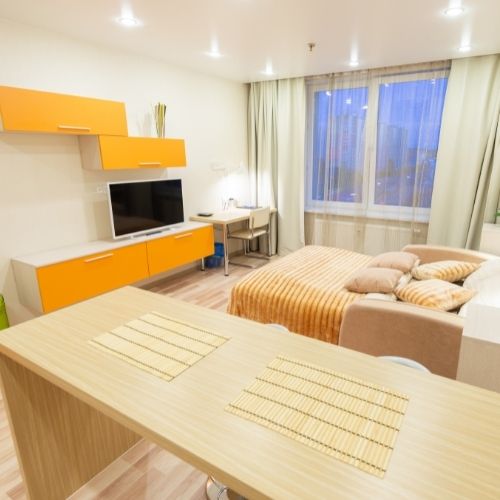
Students may choose between self-catering shared apartments (double or single rooms). Studio apartments are also available upon request for students that are 23 or older by the start of the program.
SHARED APARTMENTS

STUDIO APARTMENT
Housing & Services Fee
Semester (Fall / Spring)- Double Room in Student Residence with Self-Catering facilities and study areas, includes: utilities, wifi, maintenance service, bed linen and towels, kitchen equipment, washing machine
- (Optional) Single Room occupancy may be requested upon program application. Student opting for a single room option will be charged an additional supplement = €140 per week.
- Airport transfer and housing check-in.
- Welcome and farewell meals.
- Student Card for discounts at local sports and leisure clubs, shops and services
- 24/7 emergency assistance and on-site student consultant support.
- Social events calendar
- Volunteering with local NGOs opportunities facilitation.